We went live, once again, yesterday for our partner Strategic Solutions and shared our thoughts on how to train and re-train staff for the upcoming open enrollment season.
This session was focused on Medicare Open Enrollment but the approach and strategy we recommended would apply to any plan or seasonal event that scales up marketing and sales staff.
Leveraging journey mapping differently and focusing on training to instill empathy allows your agents to collect and leverage sentiment in real time and create lasting relationships with your customers.
Since 60% of organizations report having journey maps, you likely have seen or built journey maps already. The challenge with the vast majority of journey maps we encounter is that they are request based, not member focused. The assumed commonality in these journey maps immediately moves us away from the critical factors of empathy: Critical Listening, Conversation, and Investigation. We need to create journey maps that get down to the agent-customer connection level.
Efficient transactional processes will not help your customers view you as a trusted advisor.
Probing
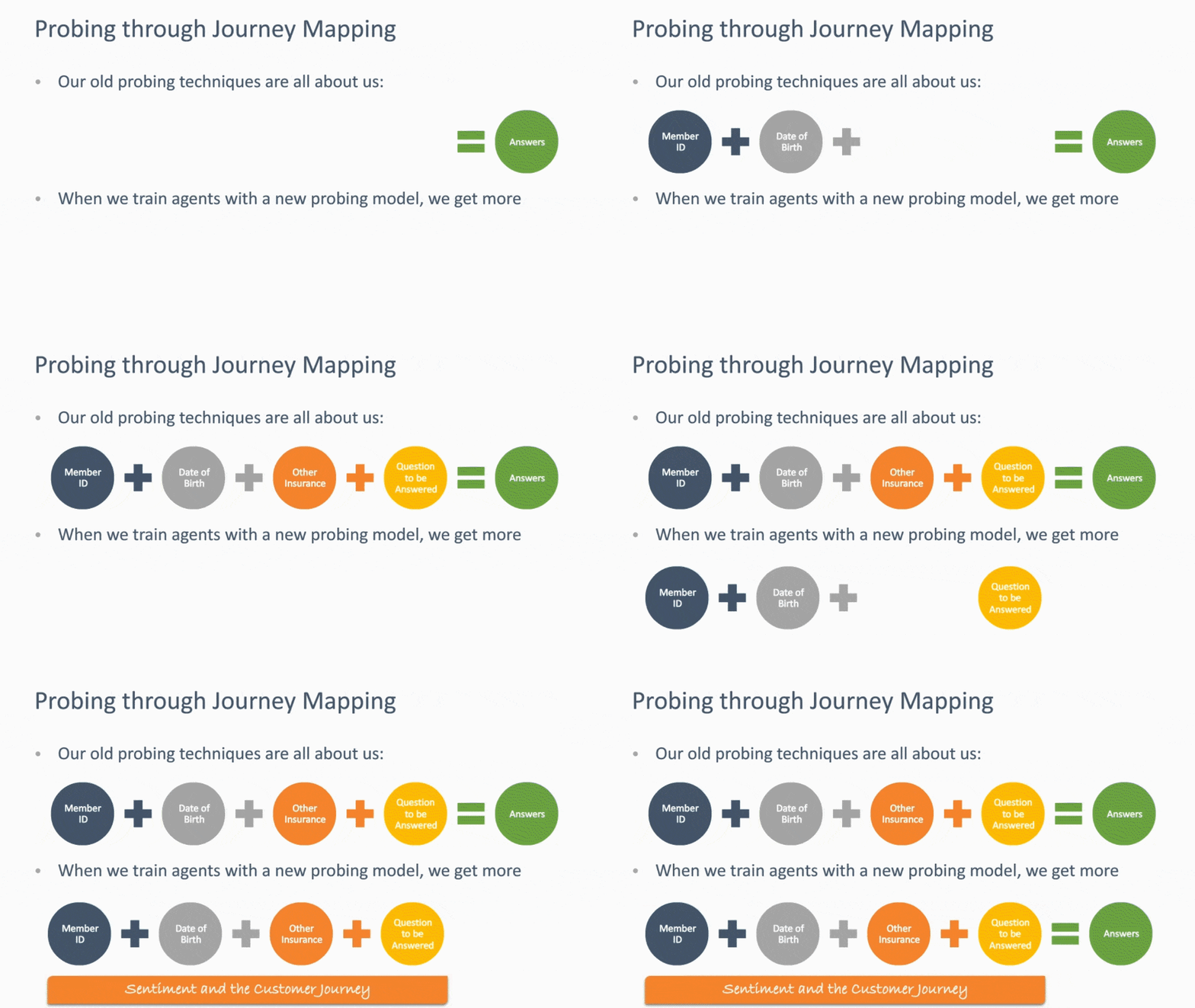
In the contact center, it all begins with the probing questions your agent asks at the start of the call. Most probing techniques used today are all about us. For example, what’s your member id? Your date of birth? What question do you have? This series of questions is well intentioned to allow the agent to move to an answer quickly. However, this takes sentiment as a tool we can leverage away.
In our new approach, we open a call by asking, “How can I help you”? This shift allows your customer to share their issue quickly and have control over the content of the call. They will start talking about their problems immediately. They may say something like, “I thought this was all handled, my son is still sick, and now I have a huge bill.”
From here, when appropriately trained, an agent can extract a lot of information.
The question: Why did my claim get denied?
Insight to who the call is about: dependent male member
Level of stress and mood
Understanding the feeling of financial pressure
Level of knowledge about the plan and process
The real question they didn’t ask: Do I have to pay this bill?
With a new approach to probing we can respond with “gee I think I have your sons record right here, can you confirm the member ID?” We’re getting the information we need but in a very different way and once we’ve allowed them a moment to vent.
In the traditional approach, we would have been talking about why the claim was denied but have left the real question on the table.
Opportunity
Now your agents have a unique opportunity to guide the sentiment. We believe that empowering agents with the tools they need to hear the sentiment right away and move to a place where it can change leads to drastically higher levels of success in the contact center.
This change occurs within the call, not after it ends. Venting is something we’ve been scared of for years. When a customer starts venting, you feel you’ve lost control of the call. In our old approach to measurement, this meant a long call, getting a supervisor involved, threating to take business elsewhere, etc. We’ve been afraid that venting changes the amount of time it takes to complete a call. But if we can start to think about venting as a way for customers to express themselves and deliver clarity of sentiment to us, we have an opportunity to engage and measure differently.
Probing through journey mapping allows a lot of learning. The benefits of this learning are that we no longer have to guess if we’ve made an impact – we immediately know! However, this approach takes a different level of skill and therefore shifted approach to training.
A Different Agent
To become an advisor, you need a different type of agent in your contact center. In healthcare specifically, this agent is made up of the following:
You never want to practice on your customer. You have to look at your agents as superheroes. But you can’t just walk down the street and buy superheroes. You have to build them. Building superhero agents are where your in-house learning programs become mission critical. Having technical expertise and empathy at the same time is very complicated.
The Zelus PACE™ program
The PACE™ program stands for:
Proficiency
Accuracy
Confidence
Empathy
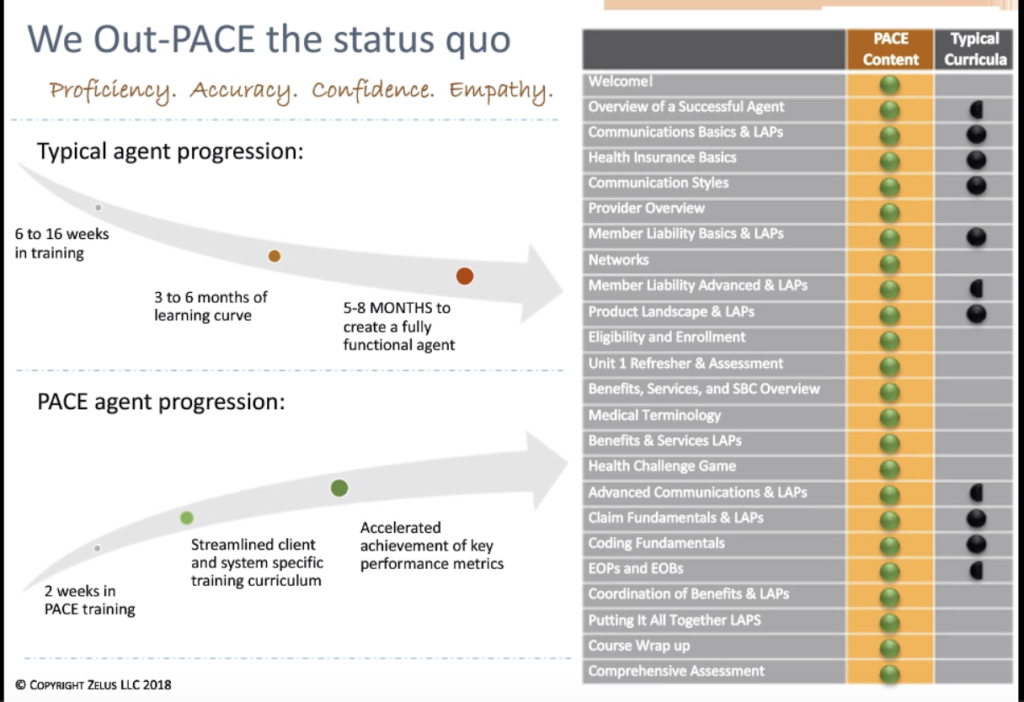
This program changes the agent’s progression. Here is what the curriculum looks like and how it compares to standard curricula.
We deliver the PACE™ program in the same or less time than typical programs. If you want to see what the full 10-day journey looks like or some specific improvement metrics from this program, let us know.
Part of what allows the PACE™ program to accomplish incredible results is that we teach soft skills and industry-specific skills in unison. In complex industries, you don’t have the luxury of training these things in isolation.
Check out the recorded session that Jenny led here which covers sentiment recognition, a case study, and even more insights into journey mapping and our PACE™ program and how it can help organizations like yours.
Are you looking to hire or become an exemplary trainer? Top training professionals are in high demand and are critical for successful projects or rollouts. Being an exemplary trainer is not rocket science. There is a formula used to become or select these elite training professionals.
When I look to hire trainers, I am selective (ok, super picky) and look beyond resume basics. As a supporter of improving training efforts across the industry, I thought I’d share with you, the five traits that guide my process for hiring exemplary trainers.
Rapid Command of the Material. Look for a trainer who has experience with learning new material quickly and can cite specific examples of how they infuse their own experience into the content during execution. This promotes relatability, relevance, and absorption of the subject matter. This allows trainers to be confident and have the freedom to adapt their teaching techniques. This enables them to encourage participants to learn from themselves and the entire class; creating as many organic learning moments as possible. If they don’t know an answer, they don’t guess; they know where to get the correct response. Trainers need to ensure that learners absorb the critical material and can adopt the positive changes to come. Ask questions of the candidates and their references that help you determine this ability.
Preparation & Practice. An exemplary trainer makes delivering a class look straightforward and seamless. Skilled trainers come with detailed and effective preparation strategies. In the interview process, ask them their specific steps of their preparation for learning a curriculum. For example, an exemplary trainer may read through the material twice in its’ entirety to get an overall feel for the flow of the course. They break down each module, highlighting and marking their instructors guide for crucial Next, they rehearse each module aloud in front of a mirror or by recording themselves to validate their timing. Trainers should not practice on students. We suggest having them demonstrate their skill and ability through a structured Train-the-Trainer program and graded teach-back process. This is where you inspect what you expect regarding their preparation, session openings, transitions, questioning techniques, use of technology and creating an environment ripe for learning.
Rhythm & Energy. There are ebbs and flows in energy during any training class. An exemplary trainer is in tune with their energy level and of their students. A quality trainer knows when dry or detailed content is coming up, and they adjust their delivery accordingly. A skilled trainer is keenly aware when learners are tuning out, restless, or distracted. They know purposeful engagement is critical. A talented trainer communicates the information in a way that ensures learners understand the material and can implement it immediately out on the floor. Seek to understand how they use the latest adult learning methodologies to facilitate engaging learning experiences, even for seasoned attendees.
Corporate Savvy, Strategic Thinkers.An exemplary trainer should possess strong business acumen and grasp how the training process affects the overall business. This understanding of the “Big Picture” of how their training ties in, will support the objectives of the project. Exemplary trainers consider the greater vision of the firm and how their role affects the entire organization. Is your trainer experienced in quickly “crossing borders” by strategically partnering with counterparts from other departments within the organization like Operations, HR, and Marketing? These essential corporate relationships combined with strategic thinking, help to strengthen the bonds between departments and foster an environment of cooperation and unity within your project. Get specific examples of how they have incorporated this mind set into their daily training activities during past projects.
Trainers are Evaluators. Exemplary trainers must be skilled in evaluating learners and measuring understanding as they train. They do this deliberately through keen observation skills, analyzing student interaction and validating content absorption via knowledge checks. It is NOT about the grade on a test; it comes down to the trainees being able to understand and practically apply the material they have learned! Trainers need to ensure learners can effectively implement the training in their specific role. This is an indispensible and hard to find trait that comes only from experience and honing their craft in learning and development. Ask how your potential trainers assess skill levels before, during and after training.
Do you see these five skills exhibited by your trainers? We do in ours! How do you gain insight into the behaviors of exemplary trainers? Be picky, observe, inspect and ask for specific, detailed examples of how these traits are demonstrated in and out of the classroom.
Zelus’ Certified Trainers are an elite group of the most experienced facilitation experts in the industry. These five traits are a part of their DNA. When it comes to a seamless implementation of a call center roll-out or initiative, our trainers are handpicked to match our core beliefs when it comes to knowledge, expertise, and passion. We are discerning and only use the savviest, most experienced learning and development professionals in the industry.
Learn more about our suite of services and the additional benefits of partnering with Zelus for your training needs here or contact us to discuss the needs of your operation.
Health insurance plans are more focused than ever on evaluating and maintaining their brand. Most plans are working to be more than simply a low-cost provider of healthcare or the plan with the biggest network. For years now, we’ve seen that singularly focused strategies like that don’t work. One of the biggest opportunities plans have is to emerge as the health plan of choice for members by choosing to deliver a personal connection in every member interaction.
This personal connection starts in your contact center. What’s interesting though, is that the push for Artificial Intelligence (“AI”) to take over customer service entirely isn’t what members really want. Members want our Contact Centers to be MORE human! And for those humans to be enabled by technology. We’re seeing this desire for a human touch in every industry but especially in healthcare. It’s one of the main reasons we created a proprietary training program to assist health plan contact centers. When Zelus trains contact center agents we always incorporate empathy, we use a simple, yet comprehensive, approach:
I’m looking forward to speaking more about this at the upcoming 9th Annual Medicare Market Innovations Forum in San Diego, CA. on a distinguished panel. The panel will be focused building a year-round branding strategy that extends beyond Medicare’s Annual Enrollment Period (“AEP”). Zelus will also be in the Exhibit Hall at the Conference, so stop by and see us. We’d love to talk about your challenges and what’s working in your organization to deliver that consistent brand experience! If you need a push in the right direction talk to us about our PACE™ program. We built a comprehensive healthcare contact center program to marry proficiency, accuracy, confidence, and empathy seamlessly. There is nothing like it in the marketplace.
We’re working on an upcoming webinar with Contact Center Week about connecting with customers on a human level, learn more and register here.
Learn more about our suite of services and the additional benefits of partnering with Zelus for your training needs here or contact us to discuss the needs of your operation.
Today, the customer experience is at the forefront of everyone’s mind. In many industries, it is an elusive goal. Industries where this is most challenging have a lot in common. Most importantly, the work of their contact center is often complex. The transactions are no longer, and maybe never have been simple. Think healthcare.
Organizations work tirelessly to create and operate contact centers that provide an exceptional member experience. That exceptional experience is the face of their brand. It’s never easy. And it can be particularly challenging when the contact center is supporting a complex good or service. Complex contact centers and the agents that work in them are usually subjected to increased levels of industry and technical jargon. Our agents are almost always new to the industry and the task of ingraining industry jargon in how they understand the work they do is even more difficult. In reality, you rarely want your agents to use that jargon on the customer. So, to the agents we say: “Learn the jargon, understand it completely, and then make it sound much simpler to customer”. If memorization isn’t the answer, what is?
The Zelus website stores cookies (including third-party cookies) on your computer, as described in our Privacy Policy, including in order to make the website available to you, to improve your browsing experience, to improve the website and to provide personalized services and advertisements to you. To learn more about how we use cookies and how to change your settings, see our Privacy Policy.
By clicking “Accept Non-Essential Cookies” you agree to the use of all cookies and by clicking “Reject Non-Essential Cookies” you refuse the use of all cookies except those strictly necessary for the operation of our website. Note that by clicking “Accept Non-Essential Cookies” you will be consenting to the tracking of your actions on our website (including by cookies, pixels, and other technologies) and the disclosure of your information obtained through these methods to third parties. By clicking on “Customize”, you can accept cookies by category. You can withdraw your consent to the use of cookies at any time.
We and our partners use information collected through cookies and similar technologies to improve your experience on our site, analyse how you use it and for marketing purposes. Because we respect your right to privacy, you can choose not to allow some types of cookies. However, blocking some types of cookies may impact your experience of the site and the services we are able to offer. In some cases, data obtained from cookies is shared with third parties for analytics or marketing reasons. You can exercise your right to opt-out of that sharing at any time by disabling cookies.
These cookies and scripts are necessary for the website to function and cannot be switched off. They are usually only set in response to actions made by you which amount to a request for services, suchas setting your privacy preferences, logging in or filling in forms. You can set your browser to block oralert you about these cookies, but some parts of the site will not then work. These cookies do not store any personally identifiable information.
Analytics
These cookies and scripts allow us to count visits and traffic sources, so we can measure and improve the performance of our site. They help us know which pages are the most and least popular and see how visitors move around the site. All information these cookies collect is aggregated and therefore anonymous. If you do not allow these cookies and scripts, we will not know when you have visited our site.
Embedded Media (Videos, Images, Presentations)
These cookies and scripts may be set through our site by external video hosting services likeYouTube or Vimeo. They may be used to deliver video content on our website. It’s possible for the video provider to build a profile of your interests and show you relevant adverts on this or other websites. They do not store directly personal information, but are based on uniquely identifying your browser and internet device. If you do not allow these cookies or scripts it is possible that embedded video will not function as expected.
Google Fonts
Google Fonts is a font embedding service library. Google Fonts are stored on Google's CDN. The Google Fonts API is designed to limit the collection, storage, and use of end-user data to only what is needed to serve fonts efficiently. Use of Google Fonts API is unauthenticated. No cookies are sent by website visitors to the Google Fonts API. Requests to the Google Fonts API are made to resource-specific domains, such as fonts.googleapis.com or fonts.gstatic.com. This means your font requests are separate from and don't contain any credentials you send to google.com while using other Google services that are authenticated, such as Gmail.
Marketing
These cookies and scripts may be set through our site by our advertising partners. They may be used by those companies to build a profile of your interests and show you relevant adverts on other sites. They do not store directly personal information, but are based on uniquely identifying your browser and internet device. If you do not allow these cookies and scripts, you will experience less targeted advertising.

![Staff Re-Training to Meet the New Challenges of Open Enrollment [Live Webinar Replay]](https://zelusllc.com/wp-content/uploads/20200618_Zelus_OpenEnrollmentWebinar_Image-1080x675.png)